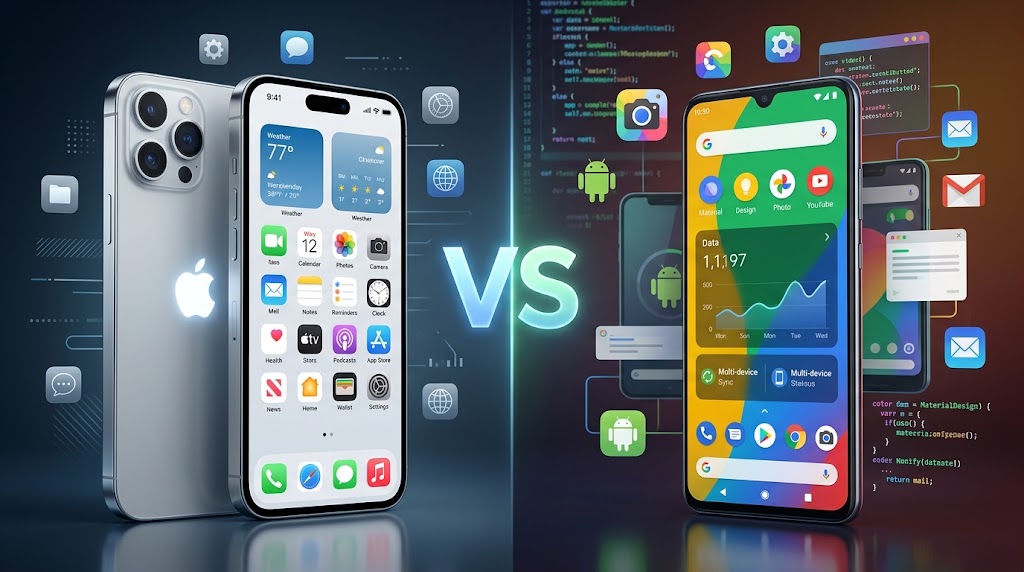
When planning to create a mobile app for the company, the initial question one needs to answer involves whether to opt for iOS app development, Android app development, or both.
For companies based in Princeton, TX, this decision influences their budget for app development, the schedule, customers they are targeting, the mobile app functionalities, and the long-term strategies in terms of growth. Although iOS and Android platforms are quite powerful, they operate in different market ecosystems, with their own requirements for development, user demographic variations, and the opportunities they provide.
The question is, which platform to choose when choosing between Android and iOS app development?
The answer to this question will depend on a number of factors, such as clients, plans for business development, budget, the app, and expansion plans.
Let’s explore the key differences so you can make a more informed decision.
- What Is iOS App Development?
- What Is Android App Development?
- iOS vs Android App Development: Key Differences
- Should You Build for iOS or Android First?
- What About Cross-Platform App Development?
- Why Choose De'Logo Studio for Mobile App Development?
- iOS vs Android Development: Which Is Better for Your Business?
What Is iOS App Development?
The process of iOS app development involves developing apps in the Apple mobile ecosystem, which comprises devices like iPhones and iPads.
Since iOS is relatively closed as an ecosystem compared to Android, the development process occurs in a more controlled hardware and software environment.
If the target audience uses Apple-based devices or the business intends to develop an app exclusively for the Apple ecosystem, then businesses can consider iOS app development.
But not all businesses will require iOS app development necessarily. It all depends on your customers and business needs.
What Is Android App Development?
Android app development involves creating applications for Google’s Android operating system.
In contrast with iOS, Android is used in devices made by various manufacturers and having different screen sizes, technical configurations, and operating systems. This allows companies to target a wide variety of users but may force developers to take into account various device configurations in their development process.
The Android platform can be considered an appropriate choice for companies that need to target as many devices as possible.
The key issue is not just how many devices Android offers, but who those Android users are.
iOS vs Android App Development: Key Differences
When evaluating iOS vs Android development, businesses should consider several important factors.
1. Target Audience
Your target audience should be one of the first things you consider.
If your existing customers primarily use iPhones, starting with iOS may make sense. If your audience is more diverse across different Android devices, Android may be the better starting point.
Before choosing a platform, research your existing website analytics, customer demographics, and current users if you already have a digital product.
Ask:
- Which devices do my customers use?
- Where are my customers located?
- What income and purchasing patterns characterize my audience?
- What devices are most common among my target customers?
- Do I need to reach customers across multiple mobile ecosystems?
Your customer data should drive the decision rather than assumptions about which platform is “better.”
2. Development Complexity
One of the major differences in Android vs iOS app development is the variety of devices involved.
The applications on Android will have to be able to work with different screen resolutions and hardware types, and potentially with different versions of Android as well, making testing more extensive.
The iOS development environment will be easier to control in this aspect, even though one would have to consider different Apple devices and OS versions.
Neither one of them could be viewed as inherently harder or easier to develop for. It really depends on the specifics of your application.
3. Development Cost
The expense associated with creating an application involves far more than just picking an iOS or Android system.
Such things as screen count, integrations, back-end support, user profiles, payment capabilities, special animations, APIs, security, and administration can greatly impact your budget.
The choice of platform can impact your cost as well.
In a case where you develop native applications for iOS and Android, you are basically making two applications for each platform.
In terms of businesses with a small budget to start off with, having your application first developed for one platform will help you validate your concept.
Cross-platform development is another way to go, and will enable some apps to reuse parts of their codebase across platforms.
4. App Development Timeline
Your development timeline will depend primarily on the complexity of your app.
A basic business application may require significantly less development work than a sophisticated marketplace, social network, booking platform, financial application, or e-commerce app.
If you choose both platforms from the beginning, your development team will need to account for both environments.
If speed to market is a priority, your development team can help determine whether launching on one platform first or using a cross-platform approach is more practical.
At De’Logo Studio, the focus is on creating customized mobile applications for startups, small businesses, and larger companies. The studio provides both iOS and Android app development as part of its mobile application development services.
5. User Experience
User experience should be a major consideration when deciding between iOS or Android app development.
iOS and Android users have different interface conventions and expectations. Simply creating one interface and copying it to the other platform may not produce the best experience.
A quality app should feel natural within the platform where it is being used.
That means your development team should consider:
- Navigation
- Buttons and controls
- Screen layouts
- Typography
- Notifications
- Gestures
- Platform-specific conventions
- Accessibility
- Performance
The goal is to maintain your brand identity while still giving users an experience that feels intuitive on their device.
6. App Store and Google Play Distribution
Another important difference involves how applications are distributed.
iOS applications are distributed through Apple’s App Store, while Android applications are commonly distributed through Google Play.
Each ecosystem has its own publishing requirements, review processes, policies, and technical considerations.
Your development team should be familiar with the requirements of the platform or platforms you choose and help prepare your application for deployment.
Planning for app store distribution early can also prevent delays toward the end of the project.
Should You Build for iOS or Android First?
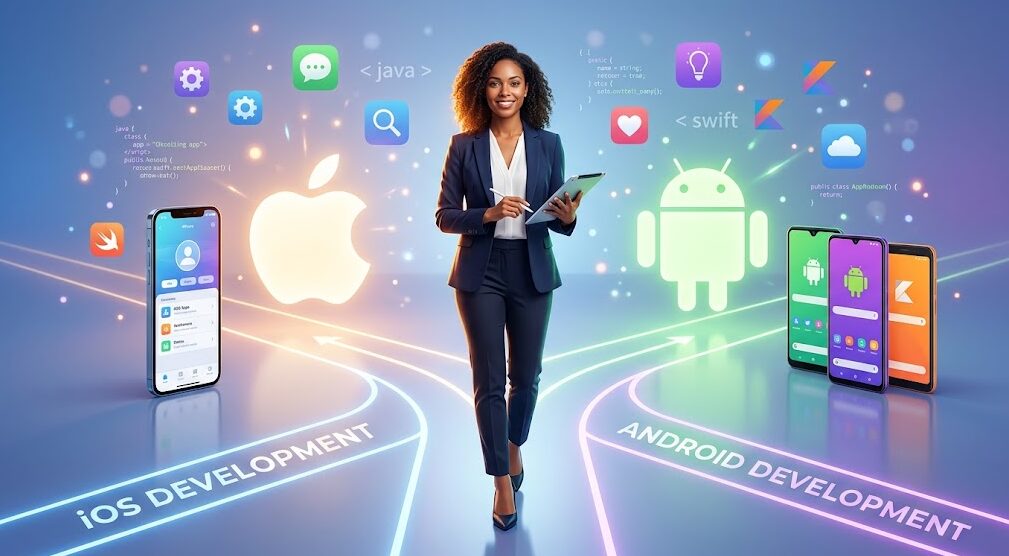
There isn’t a universal answer.
For some businesses, iOS app development may be the logical starting point. For others, Android may make more sense.
Consider starting with iOS if:
- Your target customers primarily use Apple devices.
- Your analytics show strong iPhone usage.
- Your business wants to focus on Apple’s ecosystem initially.
- Your initial launch strategy is concentrated on a specific audience.
Consider starting with Android if:
- Your customers primarily use Android devices.
- You need broad device accessibility.
- Your target audience uses a wide variety of Android phones.
- Android is more aligned with your target market.
If your customers are split significantly between both platforms, developing for both may be the stronger long-term strategy.
What About Cross-Platform App Development?
Businesses don’t necessarily have to choose between completely separate native apps.
Cross-platform development technologies can allow developers to build applications that operate across multiple operating systems while sharing portions of the codebase.
This can potentially reduce development duplication and simplify certain aspects of maintenance.
However, cross-platform development isn’t ideal for every project.
For applications that need specific platform capabilities, advanced hardware use, or very specialized functioning, a native approach to development may be appropriate. The correct solution is dependent on the needs of your application. A professional development company should be consulted during the evaluation process in order to decide whether native development for Android and iOS platforms is best or if a hybrid version should be used.
Why Choose De’Logo Studio for Mobile App Development?
Choosing the right development partner can be just as important as choosing the right platform.
De’Logo Studio provides custom mobile application development services for businesses, startups, and organizations across different industries. Its mobile app development services include iOS apps, Android apps, game development, and other custom application solutions.
The studio emphasizes customized applications rather than a one-size-fits-all approach. Its team works on application design, user experience, features, interfaces, and development based on individual business requirements.
For businesses in Princeton, TX, having a development partner that can work with both major mobile platforms can also make it easier to create a longer-term app strategy.
Instead of asking only, “Should we choose iOS or Android?” you can start with a broader question:
What mobile experience will best help our customers and our business?
iOS vs Android Development: Which Is Better for Your Business?
When comparing iOS vs Android app development, there is no platform that is universally better.
The right choice depends on your:
- Target audience
- Business model
- Budget
- App functionality
- Development timeline
- Growth plans
- Device usage data
- Geographic market
- Long-term maintenance requirements
Launching the app on just one platform initially can work out well for some firms, while others find that it is very important to reach both iOS and Android users straight away.
Regardless of what is the best option for one business or the other, it is crucial that a company makes the choice based on its own strategy of the firm, not simply going after the currently most popular option.
Final Thoughts
When developing a mobile application, deciding on the iOS or Android app development platform would be one of the very first crucial choices to make.
The development of an iOS application could be an option when your users have made substantial investments in the Apple ecosystem; however, Android app development would give you access to a wide range of users. Sometimes it might be more beneficial to support both options.
If you do not know whether to go with iOS or Android application development, it would be helpful to define your target audience, analyze your current statistics, determine the core functionality of the application, and your budget. Then talk about these aspects with a professional app development company.
De’Logo Studio provides custom mobile application development services for iOS, Android, and other platforms for companies in Princeton, TX. Our team will help you bring your ideas to life by creating a mobile product tailored specifically to your needs and business goals.
Whatever application you need – iOS, Android, or both – the development strategy that will work for you will be based on knowing your business, not choosing a technology.