- What Are the Biggest Logo Design Trends for 2026?
- Why Are Logo Trends Changing in 2026?
- What Is a Responsive Logo?
- Why Are Minimalist Logos Still Popular?
- How Is AI Influencing Logo Design?
- What are Motion-Ready Logos?
- Why Are Bold Typography Logos Growing in Popularity?
- What Is the Retro-Modern Logo Trend?
- How Are Geometric Logos Evolving?
- Minimalist Logos vs Detailed Logos: Which Works Better in 2026?
- What Colors Are Trending in Logo Design for 2026?
- How Are Sustainability Values Influencing Logo Design?
- What Logo Design Mistakes Should Brands Avoid in 2026?
- What Does the Future of Logo Design Look Like?
What Are the Biggest Logo Design Trends for 2026?
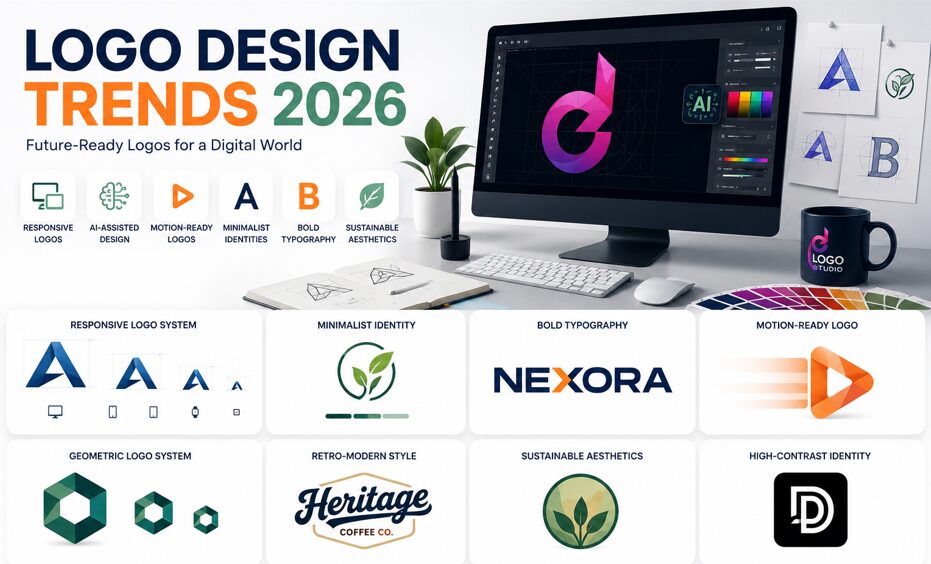
The biggest logo design trends in 2026 focus on adaptability, clarity, AI-friendly recognition, and digital-first branding.
Brands are moving away from overly complex visual identities and embracing logos that work across websites, mobile apps, social media profiles, AI-generated interfaces, smart devices, and search results.
The most influential logo trends for 2026 include:
- Responsive logos
- AI-assisted logo design
- Minimalist identities
- Bold typography logos
- Motion-ready logos
- Custom lettering
- Geometric logo systems
- Retro-modern combinations
- Sustainable brand aesthetics
- High-contrast visual identities
These trends help brands remain recognizable across an increasing number of digital touchpoints.
Why Are Logo Trends Changing in 2026?
Logo design is evolving because brands are competing for attention in increasingly crowded digital environments.
Modern logos must perform well in:
- Mobile apps
- Smartwatches
- Social media avatars
- Search results
- AI-generated summaries
- Voice assistant interfaces
- Video content
- Digital advertisements
A logo that looks great on a billboard but becomes unreadable as a profile icon is no longer effective.
The emphasis in 2026 is on flexibility, scalability, and instant recognition.
What Is a Responsive Logo?
A responsive logo is a logo system that adapts to different screen sizes and contexts.
Instead of using a single version everywhere, brands create multiple variations.
Typical responsive logo hierarchy:
- Full logo
- Simplified logo
- Icon version
- Monogram version
- Favicon version
Benefits include:
- Better mobile usability
- Faster recognition
- Improved user experience
- Consistent branding
Responsive logos are expected to become a standard requirement rather than an optional feature.
Why Are Minimalist Logos Still Popular?
Minimalism continues to dominate because simple logos are easier to recognize, remember, and scale.
Characteristics of minimalist logos:
- Fewer design elements
- Clean typography
- Limited color palettes
- Strong negative space
- Clear visual hierarchy
A simple logo performs better in:
- Mobile interfaces
- Small digital placements
- AI-generated previews
- Social media thumbnails
The trend is not about making logos boring. It is about removing unnecessary visual clutter.
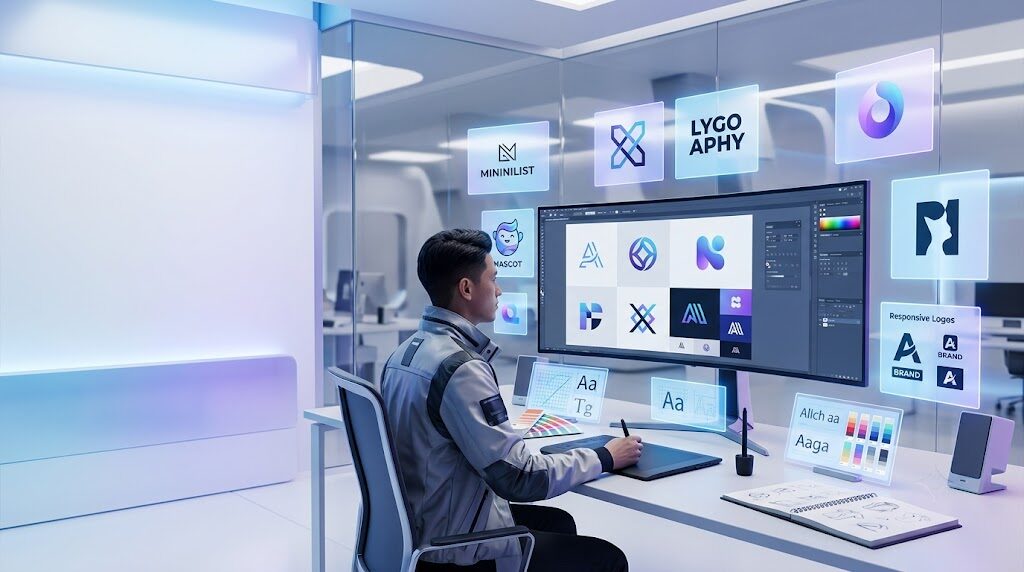
How Is AI Influencing Logo Design?
AI is changing both the creation and optimization of logos.
Designers now use AI tools to:
- Generate concepts
- Explore color palettes
- Create variations
- Test scalability
- Analyze visual performance
However, successful brands are not relying entirely on AI-generated logos.
The winning approach in 2026 combines:
- Human creativity
- Strategic thinking
- AI-powered efficiency
The result is faster design workflows without sacrificing originality.
What are Motion-Ready Logos?
Motion-ready logos are designed with animation in mind from the beginning.
Instead of creating a static mark first and animating later, designers build logos that naturally move.
Examples include:
- Morphing shapes
- Dynamic symbols
- Animated wordmarks
- Interactive brand marks
Advantages:
- Better engagement
- Stronger storytelling
- Improved brand recall
- More effective video branding
As video continues to dominate online communication, motion-ready logos are becoming increasingly valuable.
Why Are Bold Typography Logos Growing in Popularity?
Typography-driven logos are becoming a major trend because they create immediate brand recognition.
Brands are investing in:
- Custom fonts
- Unique letterforms
- Distinctive wordmarks
- Expressive typography systems
Strong typography helps brands stand out without relying on complex symbols.
Popular typography directions include:
- Extra-bold sans serifs
- Custom geometric fonts
- Condensed letterforms
- Variable typography
- Humanist type styles
Typography is becoming the logo itself rather than simply supporting it.
Typography first logos are especially effective for service-based businesses. Browse our logo design portfolio to see real-world examples.
What Is the Retro-Modern Logo Trend?
Retro-modern logos combine nostalgic influences with contemporary design principles.
This trend appeals to audiences seeking authenticity and familiarity.
Common characteristics include:
- Vintage-inspired typography
- Modern layouts
- Simplified color palettes
- Clean geometric structures
- Updated classic symbols
Rather than copying the past, designers are reinterpreting historical styles for modern audiences.
Every brand has a different personality, which is why choosing the right logo style matters. Our logo designers help businesses select the best direction based on their industry and audience.
How Are Geometric Logos Evolving?
Geometric logos remain popular because they communicate structure, reliability, and simplicity.
In 2026, designers are moving beyond basic geometric shapes.
Emerging approaches include:
- Modular systems
- Layered geometry
- Dynamic patterns
- Mathematical symmetry
- Scalable visual frameworks
Whether you need a geometric logo or a completely custom concept, our professional logo designers build scalable identities that grow with your business.
Minimalist Logos vs Detailed Logos: Which Works Better in 2026?
Factor | Minimalist Logos | Detailed Logos |
Mobile readability | Excellent | Limited |
Scalability | Excellent | Moderate |
Recognition speed | Fast | Slower |
Print flexibility | High | Moderate |
Digital performance | Excellent | Lower |
Visual storytelling | Moderate | Strong |
For most modern brands, minimalist logos provide better overall performance.
However, detailed logos still work well for:
- Luxury brands
- Heritage organizations
- Craft businesses
- Premium products
The best choice depends on brand strategy rather than trends alone.
What Colors Are Trending in Logo Design for 2026?
Color trends are shifting toward stronger contrast and more intentional palettes.
Popular directions include:
- Deep blues
- Vibrant oranges
- Digital greens
- Monochromatic systems
- Black-and-white identities
- Muted earth tones
Brands are also reducing color complexity.
Many successful logos now rely on:
- One primary color
- One secondary color
- Neutral support colors
This approach improves consistency across digital platforms.
How Are Sustainability Values Influencing Logo Design?
Consumers increasingly expect brands to communicate environmental responsibility.
This has influenced logo aesthetics through:
- Organic shapes
- Natural color palettes
- Simplified visuals
- Sustainable brand storytelling
- Eco-conscious visual language
The goal is not to look “green” artificially but to create authentic visual systems that align with brand values.
What Logo Design Mistakes Should Brands Avoid in 2026?
Common mistakes include:
- Following trends without strategy
- Using generic AI-generated logos
- Creating overly complex symbols
- Ignoring mobile scalability
- Using too many colors
- Choosing trendy fonts with poor longevity
- Neglecting accessibility
- Failing to test logo responsiveness
A successful logo should remain effective for years, not just during a temporary design trend.
What Does the Future of Logo Design Look Like?
The future of logo design centers on flexibility, intelligence, and cross-platform consistency.
Brands will increasingly need logos that can function across:
- Traditional websites
- Mobile applications
- Social platforms
- AI-powered search experiences
- Augmented reality environments
- Smart devices
- Interactive digital products
The most successful logos in 2026 will not necessarily be the most visually complex. They will be the ones who communicate instantly, adapt effortlessly, and remain memorable across every platform where customers interact with a brand.